Thought Vibration, Or the Law of Attraction in the Thought World by William Walker Atkinson First published in 1908 Edited by Rev. Lux Newman the Quimby Philosophical Society 2008 The Universe is governed by Law – one great Law. Its manifestations are multiform, but viewed from the Ultimate, there...
P. T. Barnum, the great American showman of the 19th century, wrote this short book about making and keeping money. He certainly had life experiences that qualify him for the subject–he started a small newspaper in his twenties, bought and transformed a museum into a showplace for curiosities,...
This comprehensive eBook presents the complete extant works of Marcus Aurelius with beautiful illustrations relating to Marcus' life and works. Marcus Aurelius was a Roman Emperor from 161 to 180, known as one of the last of the Five Good Emperors, and is also considered one of the most...
There is no riddle that sharp mind of detective Sherlock Holmes can’t solve. Observation, intelligence, selflessness and bravery distinguish a famous literature character created by writer Arthur Conan Doyle. The inimitable duet of Sherlock Holmes and Dr Watson sets to investigation of a crime...
Why Political Science Classics Collection is so important? In today’s world, providing quality training for the younger generation at colleges and universities is of primary importance. But higher education is not enough. Any graduate is first and foremost a citizen of his nation. He has the right...
This book contains the fundamental works of Marxism, Anarchism and Bolshevism: The Communist Manifesto, originally the Manifesto of the Communist Party, by Karl Marx and Friedrich Engels; The Conquest of Bread by the Russian anarcho-communist Peter Kropotkin; The State and Revolution by Vladimir...

Three Men in a Boat (To Say Nothing of the Dog), published in 1889, is a humorous account by English writer Jerome K. Jerome of a two-week boating holiday on the Thames from Kingston upon Thames to Oxford and back to Kingston. The book was initially intended to be a serious travel guide, with...
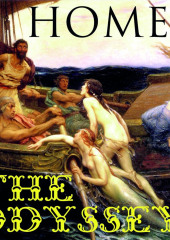
The Odyssey is one of two major ancient Greek epic poems attributed to Homer. It is, in part, a sequel to the Iliad, the other Homeric epic. The Odyssey is fundamental to the modern Western canon; it is the second-oldest extant work of Western literature, while the Iliad is the oldest. Scholars...

"This audiobook collects a magnificent set of works by Russian classical authors: Alexander Pushkin, Nikolai Gogol, Fyodor Dostoyevsky, Anton Chekhov, Leo Tolstoy, Mikhail Bulgakov, Leonid Andreyev, Maxim Gorky, Ivan Turgenev, Aleksandr Kuprin. Each original story, springing from a common...
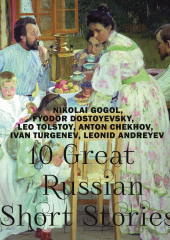
10 Great Russian Short Story. The Russian short stories that will make a vivid impression on a person: The Mantle by Nikolai Gogol, Notes from the Underground by Fyodor Dostoevsky, The Dream of a Ridiculous Man by Fyodor Dostoyevsky, The Death of Ivan Illyich by Leo Tolstoy, Darkness by Anton...
Notes from Underground also translated as Notes from the Underground or Letters from the Underworld, is an 1864 novella by Fyodor Dostoevsky. Notes is considered by many to be one of the first existentialist novels. It presents itself as an excerpt from the rambling memoirs of a bitter, isolated,...
The Charmides (Greek: Χαρμίδης) is a dialogue of Plato, in which Socrates engages a handsome and popular boy in a conversation about the meaning of sophrosyne, a Greek word usually translated into English as «temperance», «self-control», or «restraint». As is typical with Platonic early dialogues,...
In Plato's Ion (Greek: Ἴων) Socrates discusses with the titular character, a professional rhapsode who also lectures on Homer, the question of whether the rhapsode, a performer of poetry, gives his performance on account of his skill and knowledge or by virtue of divine possession. It is one...
Plato was a philosopher in Classical Greece and the founder of the Academy in Athens, the first institution of higher learning in the Western world. He is widely considered the most pivotal figure in the development of philosophy, especially the Western tradition. Unlike nearly all of Plato's...
The Allegory of the Cave, or Plato's Cave, was presented by the Greek philosopher Plato in his work Republic (514a–520a) to compare «the effect of education (παιδεία) and the lack of it on our nature». It is written as a dialogue between Plato's brother Glaucon and his mentor Socrates,...
he Republic (Greek: Πολιτεία, Politeia; Latin: Res Publica) is a Socratic dialogue, written by Plato around 375 BC, concerning justice (δικαιοσύνη), the order and character of the just city-state, and the just man. It is Plato's best-known work, and has proven to be one of the world's...
The Laches (Greek: Λάχης) is a Socratic dialogue written by Plato. Participants in the discourse present competing definitions of the concept of courage. Laches – Athenian general and statesman, son of Melanopus. Famous dialogues of Plato – Early: Apology, Charmides, Crito, Ion, Euthyphro, Hippias...
The Apology of Socrates was written by Plato. In fact, it’s a defensive speech of Socrates that he said in a court noted down by Plato. The main subject of the speech is a problem of the evil. Socrates insists that neither death nor death sentence is evil. We shouldn’t be afraid of the death...
The Menexenus (Greek: Μενέξενος) is a Socratic dialogue of Plato, traditionally included in the seventh tetralogy along with the Greater and Lesser Hippias and the Ion. The speakers are Socrates and Menexenus, who is not to be confused with Socrates' son Menexenus. The Menexenus of...
Lysis (Greek: Λύσις), is a dialogue of Plato which discusses the nature of philia (φιλία), often translated as friendship, while the word's original content was of a much larger and more intimate bond. It is generally classified as an early dialogue. The main characters are Socrates, the boys...
Показать ещё